Prepare with purpose.
Select the practical and review relevant learner adjustments. Assign a short pre-practical pack.

FOR SCHOOLS, SCIENCE TEAMS & SENCOS
A planned pathway that connects preparation, classroom support and progress review—so practical inclusion becomes easier to understand and improve.
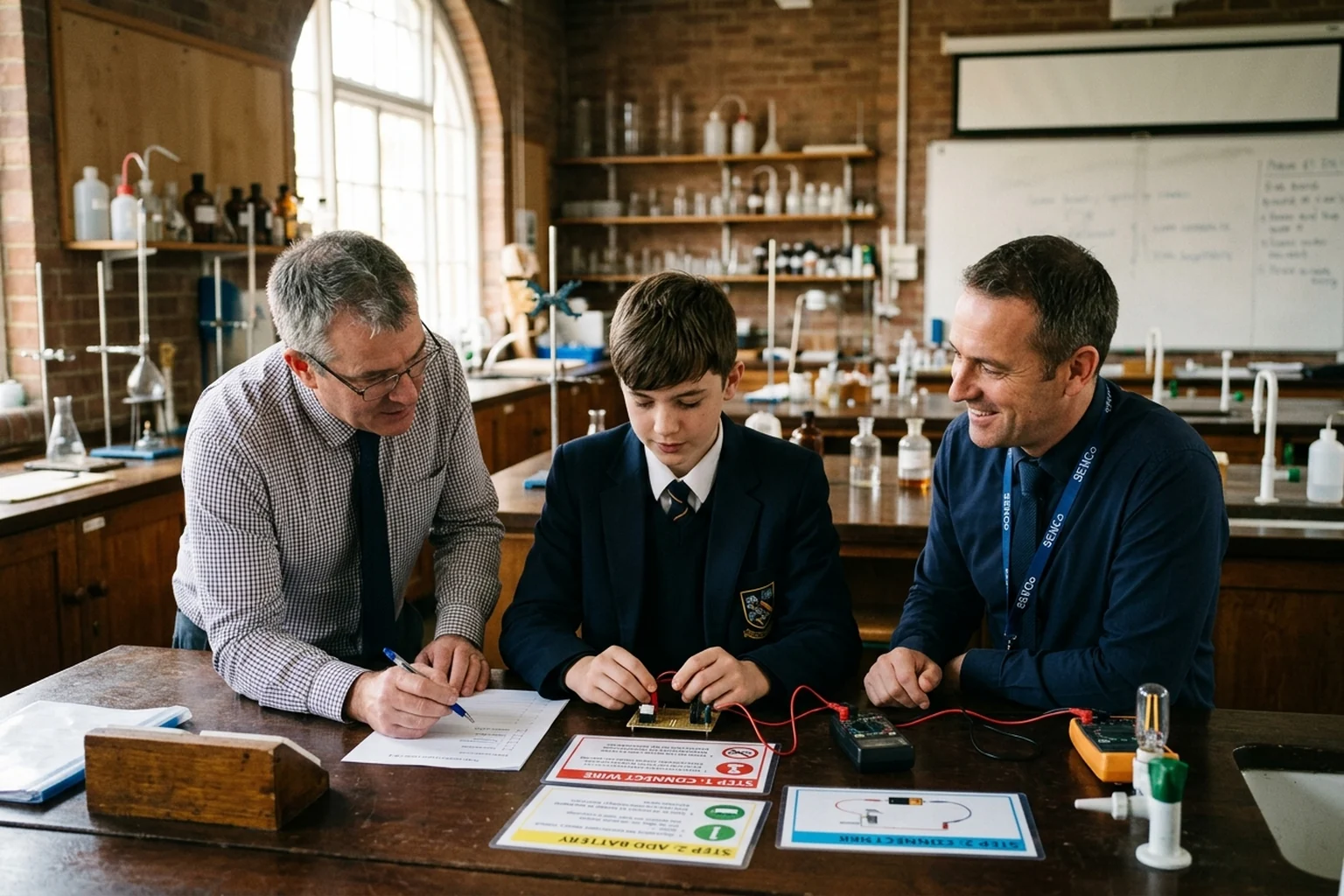
DESIGNED FOR THE SCHOOL DAY
FIXSTEM’s proposed school view follows the practical from assignment to review, with teachers making the decisions.
Select the practical and review relevant learner adjustments. Assign a short pre-practical pack.
See incomplete preparation and uncertain responses early. Plan a check-in or supported rehearsal.
Record first actions, prompts and work samples alongside the support provided.
Agree the next learning goal and adjust the scaffolds for the following practical.
THE PROPOSED MASTERY PORTFOLIO
Switch perspectives to see how the same fictional evidence can support a teacher, a SENCo and a family.
The learner recorded the result with one reminder about units. Retain the units cue and model how repeat readings improve confidence in a result. Review whether the cue is still needed next time.
Review the support used, staff observations and the completed explanation together. Compare across lessons before concluding that independence has improved. Use the record to inform SEN Support or EHCP review contributions.
Your child explained how two measurements were related. Ask them what “current” means and why they would repeat a measurement. The next school goal is to explain how a method could be improved.
INCLUSION, MADE VISIBLE
Schools need to understand whether an adjustment is helping a pupil access, participate and learn.
The planned portfolio would bring together evidence schools can draw on in inclusion discussions, SEN Support reviews, EHCP review contributions and conversations with Ofsted about their provision.
FIXSTEM is not endorsed by Ofsted. No dashboard guarantees an inspection judgement, and evidence should reflect everyday teaching rather than create paperwork solely for inspection.
Read Ofsted’s school inspection guidanceWhat barrier was identified? What support was provided?
What did the learner do? What does their work show?
What changed over time? What will staff adapt next?
KEEP THE SCIENCE CHALLENGING
Chunking, spoken instructions and recording frames are candidate supports, not fixed prescriptions for a diagnosis. Teachers should choose them in response to a specific barrier and review whether they remain useful.
Read the research and evaluation approachShow how to plan, monitor and evaluate a practical task.
Record the support used alongside the work produced.
Look for independent use on a later task before assuming mastery.
A FOCUSED FIRST PILOT
Six KS3/GCSE practicals in one partner school is the initial MVP plan, targeted over 3–6 months once delivery resources and a partner are in place.
Partner commitments, pricing and pilot outcomes are not yet established. School data governance and specialist assessment input are pre-pilot work.
Explore a partnership